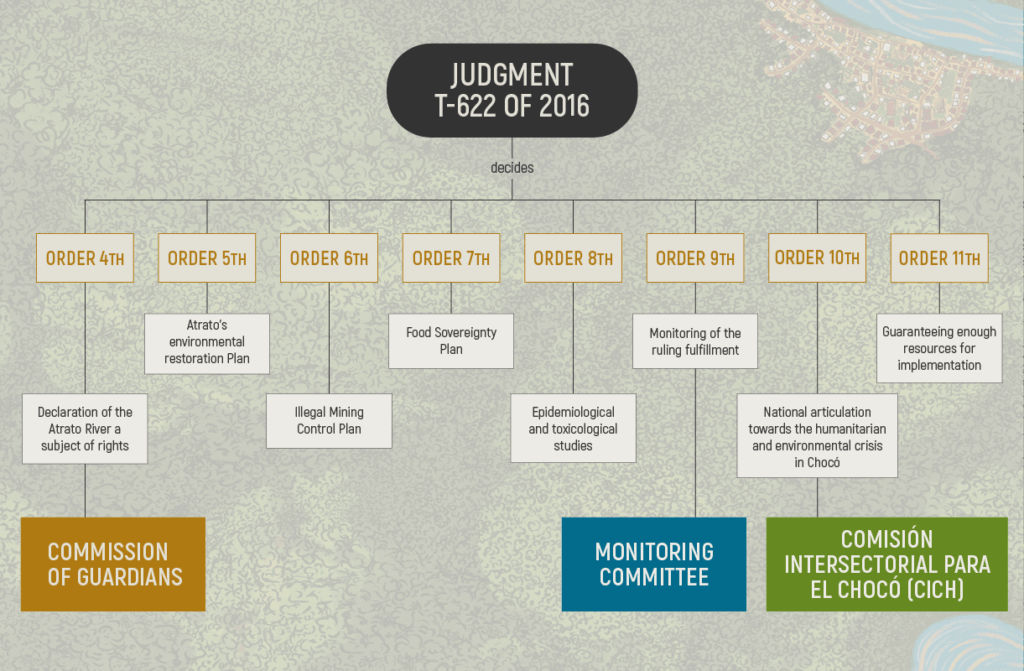
The T-622 is a complex judgment that demands the action of multiple entities and actors, aiming to comprehensively address the territory. The Court established some mechanisms and articulation instances for the duly implementation.
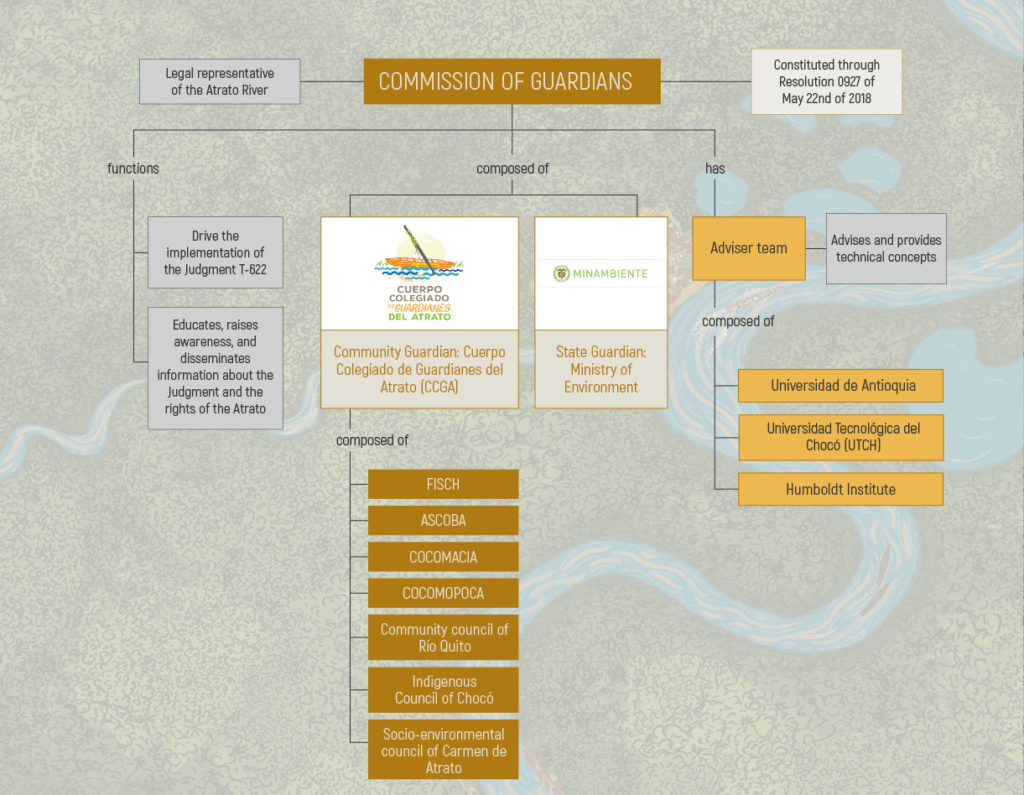
COMMISSION OF GUARDIANS OF ATRATO
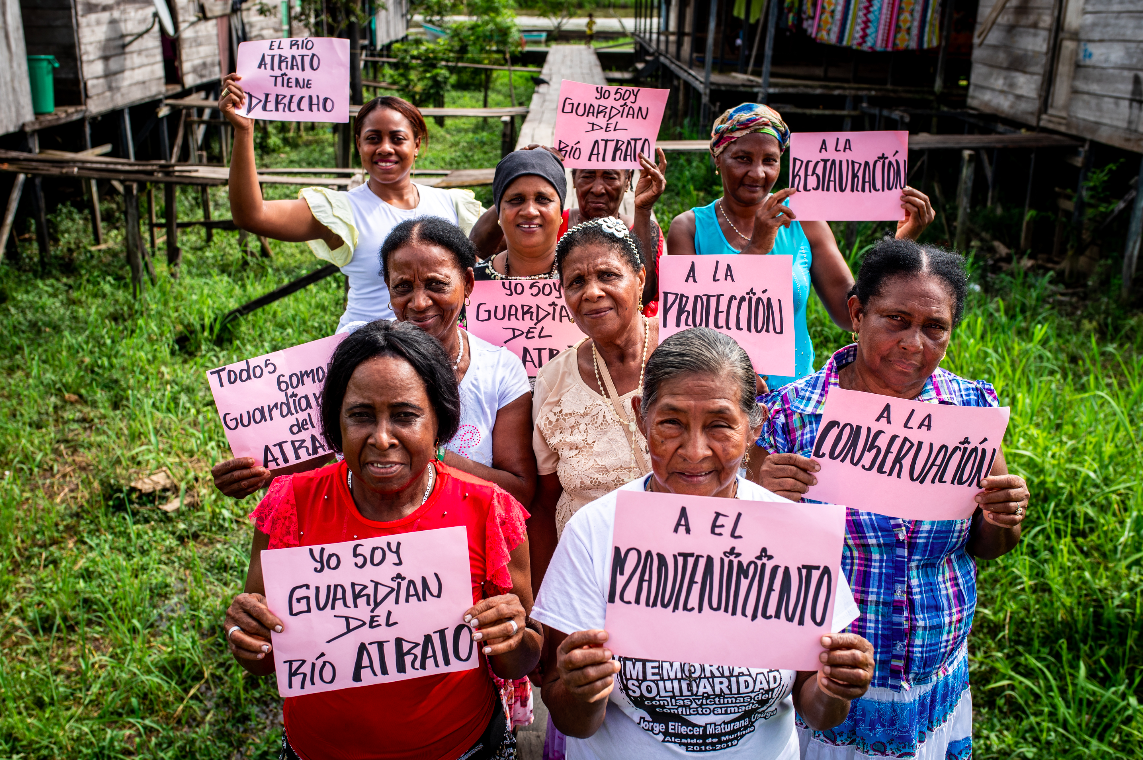
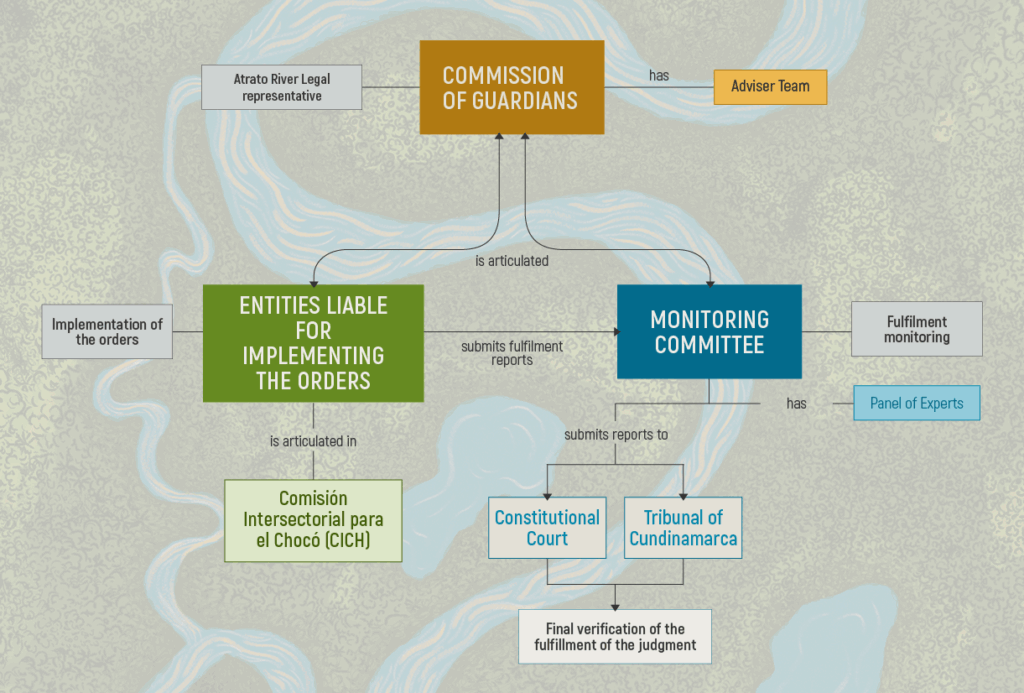
The Commission of Guardians of Atrato is the organism constituted as the legal representative of the Atrato River and looks after its rights to be respected. It is composed of the Ministry of Environment as the State guardian, and the Cuerpo Colegiado de Guardianes del Atrato as the community guardian. The Commission of Guardians has an Adviser Team that provides technical concepts and advises the guardians about the required aspects.
The Commission of Guardians implies an unprecedented execution of governance and collective decision-making between the Government and communities. It is the highest instance of decision making around the judgment and implies a horizontal relationship between the institutionality and the community organisms of representation.
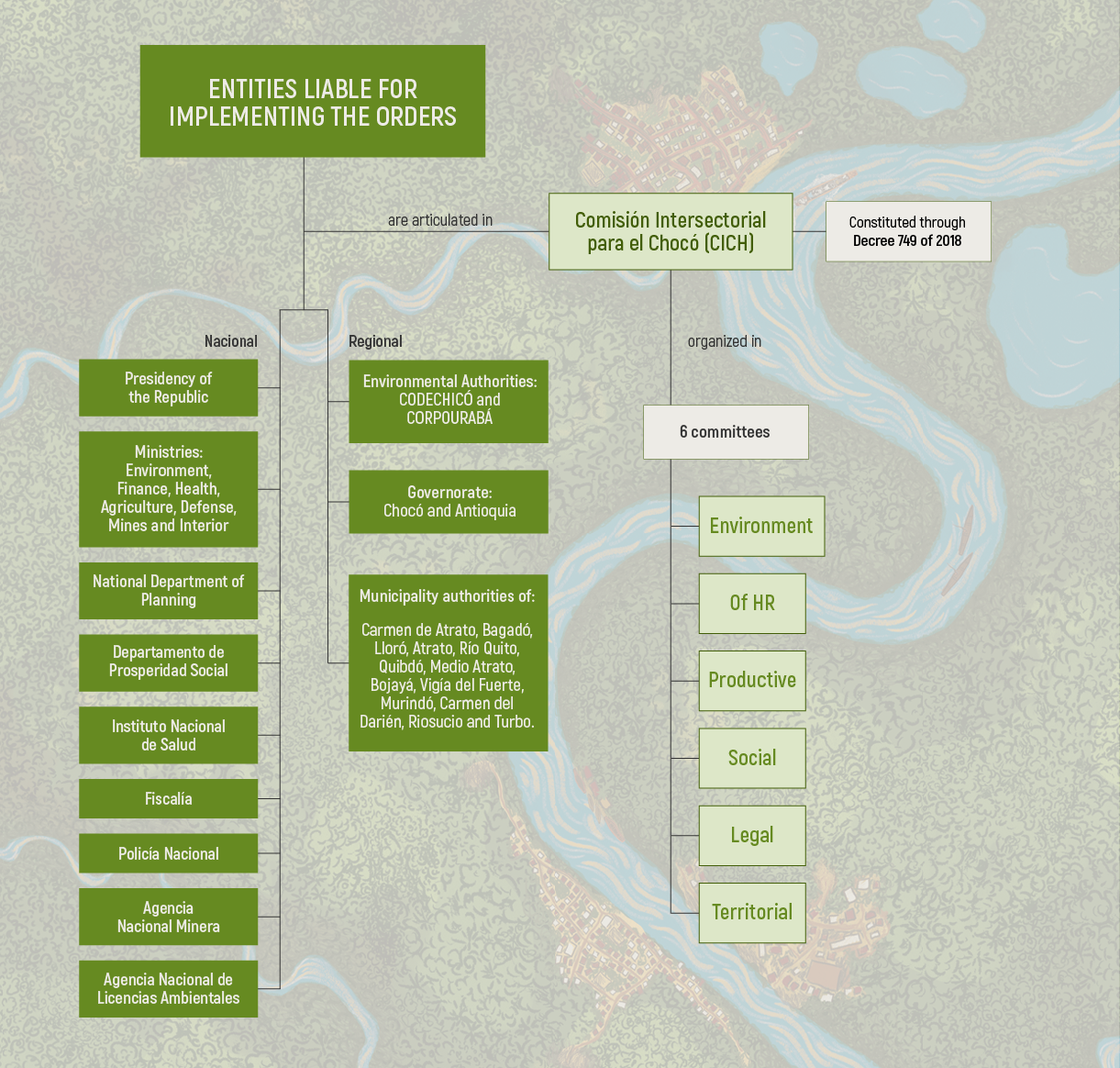
INSTITUTIONS LIABLE FOR THE ORDERS
The following are the respondent entities and those the Court considered liable for the violation of rights due to omission against the humanitarian and environmental crisis of Atrato. They are in charge of executing all the actions and plans ordered by the Court.
In the tenth order, the judgment ordered the creation of the Comisión Intersectorial para el Chocó (CICH), as an articulation instance of the National Government to comprehensively address the watershed.
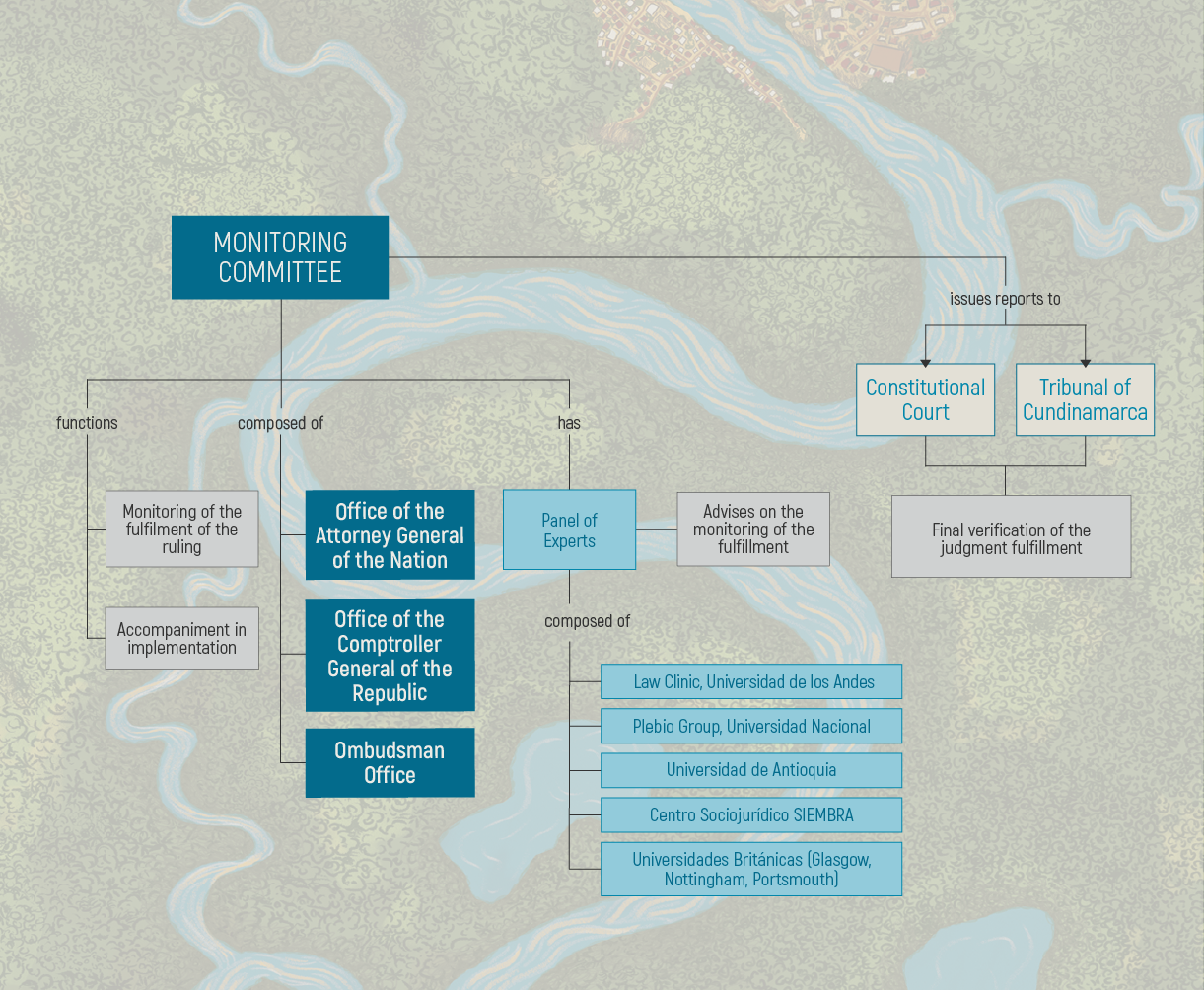
Monitoring committee
It is in charge of monitoring the fulfillment of the ruling and accompanying the implementation institutions. For that, it issues half-yearly Monitoring Reports that are reviewed by the Tribunal of Cundinamarca and the Constitutional Court. The Committee has a Panel of Experts that advises it regarding its duty.
ARTICULATION BETWEEN ACTORS
Thus, the architecture for the implementation of the judgment is summarized as follows:
Invited columnists: Viviana Gonzáles and Rodrigo Rogelis, members of the Centro Sociojurídico para la Defensa Territorial Siembra, legal attorneys of the petitioners of the judgment T-622 of the Atrato River.
In order to guarantee the protection and decontamination of the Atrato River, in Chocó, Colombia, the judges of the Constitutional Court declared it a “subject of right”. Six years after the judgment, there is still a lot to do. This is a collective work with the journalist Marie Eve Detoeuf, from “Le Monde”.
The Guardians of Atrato, along with the Centro Sociojurídico Siembra, will submit next Thursday, November 3rd, a petition to the Constitutional Court for the fifth anniversary of the Judgment T-622, the first to acknowledge a River a subject of rights. In the text, the status of the implementation of the judgment is identified, and even though it has progressed, it has not been fully fulfilled.
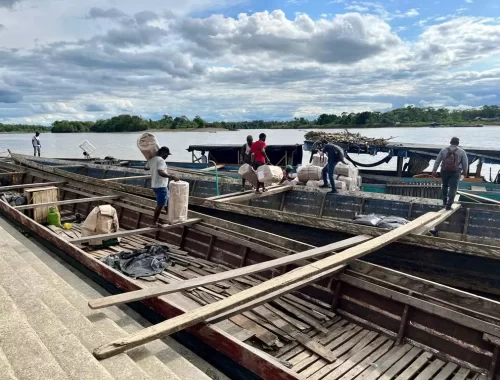
“The judgment T-622 of the Constitutional Court? Everybody here knows it”, says José Adán Palacios, while he charges his boat on the pier of Quibdó. José Adán, who is from Bojayá, transports passengers and merchandise, and knows better than anyone this majestic River and its watersheds. “But the judgment has not changed a thing; the contamination carries on, whether it is due to the mining, deforestation, or trash”, the boatman sighs.